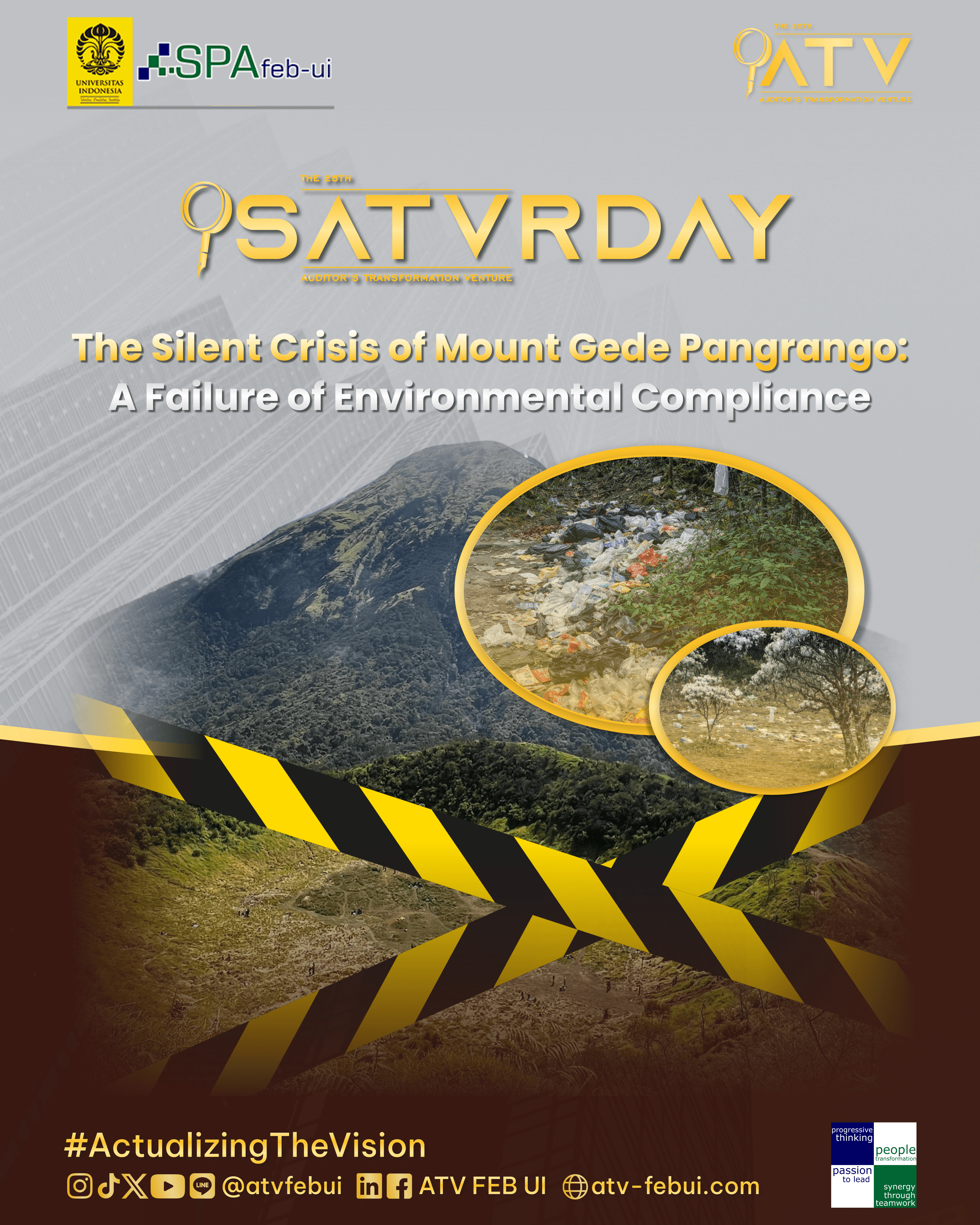
The Silent Crisis of Mount Gede Pangrango: A Failure of Environmental Compliance
Faculty of Economics and Business, Universitas Indonesia
In conservation areas, mountains usually “rest” because of natural forces—eruptions, landslides, or extreme weather. However, the recent closure of Mount Gede Pangrango was not triggered by nature, but by a management failure in controlling uncontrolled visitor waste. The issue, therefore, is not merely about irresponsible hikers. From an audit perspective, the auditee is the park management. When littering becomes systemic and forces a total shutdown, the problem reflects a breakdown in the control system that should have prevented such behavior in the first place.
Formally, the governance structure appears adequate. The park implements a quota system, requires online booking through SIMAKSI, establishes hiking regulations, and imposes administrative sanctions such as blacklisting violators. On paper, these mechanisms signal regulatory compliance and structured oversight. Yet field evidence tells a different story. During a recent cleanup operation, officers and volunteers removed more than 115 kilograms of waste, largely plastic packaging and bottles, from the hiking trails. Patrol teams reported piles of trash resembling “mini-landfills” at several points along the routes. The accumulation became severe enough to compel the National Park Authority to temporarily close the mountain in order to implement a Zero Waste tourism program and restore the ecosystem. The necessity of a full closure demonstrates that monitoring mechanisms failed to detect and mitigate risks at an earlier stage.
The environmental significance of Mount Gede Pangrango amplifies the gravity of this failure. Covering approximately 22,851 hectares, the park functions as a critical habitat for endemic flora and fauna and serves essential hydrological and ecological roles for West Java, including surrounding urban regions. At the same time, its popularity as a hiking destination increases exposure to anthropogenic pressure. High visitor intensity in a high-conservation-value area elevates environmental risk. From an audit standpoint, this raises the issue of materiality. Environmental degradation in such a strategically significant ecosystem cannot be treated as a minor operational issue; even small weaknesses in control can produce materially adverse impacts.
Analyzing this case through the lens of the Committee of Sponsoring Organizations of the Treadway Commission (COSO) Framework reveals that the problem is not the absence of regulations, but deficiencies in internal control components. Control activities appear to focus primarily on regulating the quantity of hikers through quotas, rather than ensuring the quality of their compliance in the field. Monitoring activities seem insufficient, as large-scale waste accumulation indicates a failure of ongoing supervision and timely corrective action. Information and communication mechanisms may not effectively internalize environmental responsibility among visitors. Moreover, weaknesses in the control environment—particularly in cultivating a culture of accountability and conservation ethics—suggest deeper governance concerns. In this sense, the closure reflects systemic internal control deficiencies rather than isolated misconduct by individuals.
When benchmarked against environmental management principles such as those outlined by the International Organization for Standardization in ISO 14001, the shortcomings become clearer. ISO 14001 emphasizes the Plan–Do–Check–Act (PDCA) cycle as the foundation of environmental management systems. Planning requires identifying environmental risks associated with hiking activities. Implementation involves enforcing controls such as quotas, waste policies, and educational initiatives. The “Check” phase demands continuous monitoring of environmental performance, while the “Act” phase requires corrective measures and continuous improvement. The fact that waste accumulated to a crisis level indicates failure particularly in the “Check” and “Act” stages. Continuous monitoring did not function effectively, and corrective measures were reactive rather than preventive.
The implications of this control failure extend beyond environmental damage. Operationally, the temporary closure disrupted tourism activities and required additional resources for cleanup and restoration. Reputationally, repeated incidents risk eroding public trust in the park authority’s ability to manage conservation areas responsibly. When regulatory mechanisms exist but fail in practice, institutional credibility weakens. Over time, such governance shortcomings may undermine the legitimacy of the authority entrusted with protecting the ecosystem.
Reconstructing the control system requires more than reiterating prohibitions. First, digital management tools such as online booking systems must be integrated with risk-based field supervision, ensuring that data on visitor numbers translates into targeted monitoring on the ground. Second, supervision should prioritize high-risk periods and locations, particularly during peak seasons and at commonly congested sites. Third, internal audits of environmental performance should be conducted routinely to evaluate the effectiveness of controls. Finally, enforcement must be combined with structured education strategies to build a culture of compliance rather than relying solely on punitive measures.
Ultimately, the closure of Mount Gede Pangrango illustrates that environmental degradation in conservation areas is not only an ecological issue but also a governance failure. The presence of regulations is insufficient if implementation, monitoring, and continuous improvement mechanisms do not function effectively. From an audit perspective, this case underscores a fundamental principle: control systems must be evaluated not by their design alone, but by their operational effectiveness in safeguarding what they are meant to protect.
References
- Taman Nasional Gunung Gede Pangrango. (n.d.). Syarat & Ketentuan. TNGunungGedePangrango.org. Retrieved from https://tngununggedepangrango.org/syarat-ketentuan/
- Taman Nasional Gunung Gede Pangrango. (n.d.). Retrieved from https://tngununggedepangrango.org/
- Alamsyah, A., & Sinaga, R. (2022). [Judul lengkap artikel jika tersedia]. InJAST (Journal of Innovative Research in Applied Science and Technology). Retrieved from https://journal.unpak.ac.id/index.php/InJAST/article/view/3678
- JSKPM: Jurnal Sains, Kesehatan & Pendidikan Masyarakat (IPB). (2021). Analisis Konflik Pengelolaan Sumberdaya Alam di Kawasan Taman Nasional Gunung Gede Pangrango. Retrieved from https://ejournal-skpm.ipb.ac.id/index.php/jskpm/article/view/174
- Eco-Management and Audit Scheme. (n.d.). Wikipedia. Retrieved from https://en.wikipedia.org/wiki/Eco-Management_and_Audit_Scheme
- JIaKES: Jurnal Ilmiah Akuntansi, Keuangan & Ekonomi Syariah (Ibik). (2020). Analysis of Integrated Audit Approach in Auditing Sustainable Energy Development Programs in State-Owned Enterprises. Retrieved from https://jurnal.ibik.ac.id/index.php/jiakes/article/view/3058